The Blank Page
How to Build What Doesn't Exist and Lead Where No One Has
Do not follow where the path may lead. Go instead where there is no path and leave a trail.
The Leadership Book for the AI Era
Have you ever stood at the edge of everything you know and realized that the next step was yours alone? Every leader eventually faces this moment. Not a step backed by a case study. Not a step designed or validated by someone who came before you. A step into territory where no plan exists, where the data has not been collected, and where the only authority you can cite is your own judgment — which is the very thing you are not sure you can trust.
That feeling has a name. It is Frontier Leadership, and it is becoming the defining work of the next decade.
Artificial intelligence is opening frontiers faster than the existing blueprints can be revised. Autonomous systems, converging technologies, and industries that did not exist five years ago are being authored in real time by people who had no permission to start. The leaders who will matter most in the years ahead are not the ones who can execute the best existing plans. They are the ones who can author what comes next.
The Blueprint Hierarchy
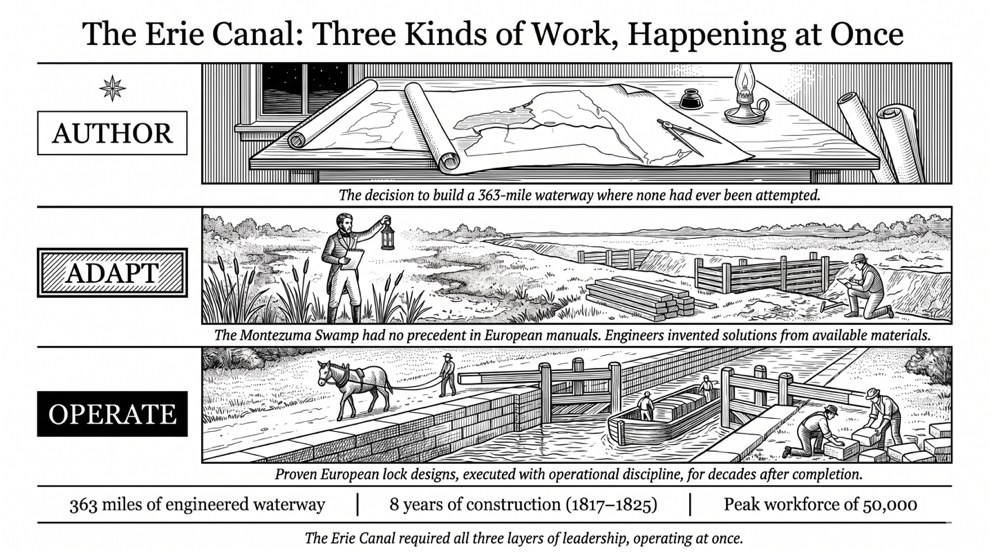
The Blank Page introduces a framework for understanding leadership not by rank or personality, but by the terrain the leader is standing on. Three modes. One continuum.
Operate
Run the proven system. Apply collective knowledge and tested experience to known scenarios.
Adapt
Work the edges. Modify and extend existing systems where they begin to fray against conditions their designers never anticipated.
Author
Build what does not yet exist. No blueprint, no proof, no one who has done it to follow. The defining work of the next decade.
The best leaders can do all three. Most leaders never master the third. The Blank Page is the first framework built not for the leader executing a known plan, but for the leader writing the next one.
Inside the Book
Drawn from three decades of building systems where none existed — across post-war Sri Lanka, humanitarian crises, the United States EMS Compact, and emerging industries in AI, aerospace, and medicine — The Blank Page reframes leadership through a single question: what does the terrain demand?
Chapters
Why leadership at the frontier requires a different framework — and why the moment, not your title, decides which one applies.
- The Comfort of the Known
- The Blueprint Hierarchy
- Where the Map Ends
- The Blueprint Trap
Interlude: The Horse and the Machine
- The Weight of the Blank Page
- Deciding Before the Data Is Complete
- Building Credibility Without Precedent
- Assembling a Team for Undefined Work
Interlude: The Truck Driver and the Ship
- The Blank Page You Hand Someone Else
- Learning by Doing It Wrong
- The Courage Gap
Interlude: The Company That Killed Itself
- From Blank Page to New Blueprint
- The Dreamer Trap
- The Next Blank Page
- Appendix A: The Frontier Toolkit
- Appendix B: Theoretical Foundations and Testable Propositions
Who This Book Is For
This book is for leaders who have arrived at a moment where the playbook stops working. The data is incomplete. The precedent does not apply. Someone has to author the next step, and no one has appointed an author. If you have ever been that person — or you are about to become one — this book is written for you.
About the Author
Donnie Woodyard, Jr. has spent three decades building what did not exist. He led the first national emergency medical training initiative in post-war Sri Lanka, supported humanitarian operations during the world's largest refugee crisis at Menik Farm, and serves as the founding Executive Director of the Interstate Commission for EMS Personnel Practice — the governing body of the United States EMS Compact, adopted by 25 states and counting. He is the author of six books, including Across State Lines, The Dark Ages of EMS, and Beyond the Tents of Menik Farm. He keynotes regularly on AI in emergency response, frontier governance, and the future of professional practice.
The Blank Page is dedicated to the team in Sri Lanka who carried it further than he could; to the Commissioners and visionaries of the U.S. EMS Compact, who are still carrying it; and to the leaders building at the frontier of AI, aerospace, and medicine, who work without maps and accept the risks.
Read or Listen to Chapter One
The opening chapter of The Blank Page — free to read and listen to right here. Like what you find? The full book is available now.
Two years into my career as a paramedic, working out of a station in a mid-sized city that generated enough volume to keep you sharp but not so much that you forgot the weight of each one. The radio cut through the bunk room with the flat, clipped language that meant someone's night had just changed. Motor vehicle accident. Entrapment. Two patients. My ambulance and a fire engine en route.
I was in the ambulance before the dispatcher finished. Boots, jacket, a quick gulp of coffee. The diesel engine caught on the first turn, and we rolled out into a cold that smelled of wet asphalt and exhaust. Outside the windshield, the streetlights pulsed past in a rhythm aligned with the red flashing lights. My partner had already responded to hundreds of similar emergencies. It was second nature.
On scene, the blueprint took over.
I should explain what I mean by that word, because it is the central idea of this book. A blueprint, as I use it here, is any proven plan someone else has already figured out. A clinical protocol. A regulatory process. An operational playbook. A market-validated business model. An engineering standard. A military doctrine. A management theory. The form varies. The principle is the same. Someone solved this problem before you, and the blueprint is how they passed that solution forward.
On the shoulder of that road at 2 a.m., the blueprint was a set of clinical protocols, and it took over completely. There was no moment of hesitation. No pause to consider options. No committee meeting. The protocols existed. The training existed. The equipment was staged in a sequence that someone, years before I ever climbed into an ambulance, had determined through trial, repetition, and, in some cases, through loss. I assessed. I stabilized. I treated. I transported. The clinical algorithm ran in my head: step follows step. Decision follows assessment. Action follows decision.
The first patient survived.
The second did not.
The outcome, as devastating as it was, did not change the fact that the system worked. The blueprint worked. Every protocol I followed that night had been written by someone who had faced a version of this call before me. Every piece of equipment had been tested. Every drug dosage had been validated. I was standing on the shoulders of decades of accumulated knowledge, distilled into a set of instructions that allowed me to act with speed and precision at a moment when speed and precision meant the difference between life and death.
That is the power of a blueprint.
• • •
I have lived inside an additional blueprint for well over a decade. Two decades after that paramedic shift, I became a pilot. The cockpit is a different room from the back of an ambulance, but the discipline is the same. Before the engine starts, a pilot runs a checklist. Before takeoff, another. Before landing, another. The checklists exist because aviation, more than almost any field on earth, has accepted what most industries still resist: that the human mind, under pressure, will forget the obvious. The checklist is not a substitute for the pilot's judgment. It is the scaffold that frees the judgment to be used where it actually matters.
When something goes wrong in flight, the first move is not improvisation. It is the relevant emergency checklist. Engine failure has a checklist. Cabin smoke has a checklist. Loss of pressurization has a checklist. They were written, sometimes in blood, by pilots who faced the situation before you and found a sequence of actions that worked. To follow that sequence under pressure is not the abandonment of skill. It is the application of skill in the form the moment requires.
The roadside at 2 a.m. and the cockpit at thirty-seven thousand feet are running the same logic. So is the surgeon at the table, the engineer reviewing the load calculation, the operations team closing the books at month-end. The blueprint exists. The leader's job is to run it well.
• • •
A blueprint, more formally, is a codified solution to a recurring problem. It is what an organization knows how to do reliably, captured in a form that allows someone other than the original problem-solver to do it again. Standard operating procedures are blueprints. So are clinical guidelines, financial controls, performance management systems, audit frameworks, project plans, sales playbooks, and the thousand quieter routines that govern how an organization actually runs on a Wednesday afternoon.
That assumption is not wrong. When the problem in front of you has been solved before, in conditions reasonably similar to yours, the highest-leverage thing a leader can do is execute the blueprint with discipline. Inventing a new approach in that situation is not creativity. It is waste.
But notice what the blueprint quietly requires. It requires that the problem in front of you resembles the problem that produced the protocol. It requires that the conditions under which you operate resemble those under which the protocol was validated. It requires that the world stay close enough to the world the blueprint was built for. When those conditions hold, blueprint leadership is the right leadership, and almost nothing else matters.
The trouble begins when those conditions no longer match.
• • •
Blueprints matter. They matter enormously.
There is a comfort in blueprints that is easy to underestimate. When you know the next step, when you can see the path laid out in front of you, when the expectations are clear, and the process is proven, there is a steadiness that allows you to focus your energy on execution rather than invention. That steadiness is not laziness. It is efficiency. It is the accumulated intelligence of everyone who solved this problem before you, compressed into a system that lets you solve it faster and with fewer mistakes.
Blueprints save time. They save money. They save lives.
They will never be enough.
• • •
Long before that 2 a.m. call, before I had any language for any of this, someone handed me a blank page on purpose.
I was fourteen. A man who owned a small engineering firm hired me for the summer to learn AutoCAD. On the first day, he walked me into an office he had set up for me. A computer. A stack of manuals: Windows 3.1, MS-DOS, AutoCAD version 1.0. In the center of the desk, a single sheet of graph paper with a three-dimensional cube drawn in pencil.
He said my job was to learn to draw that cube on the computer. I asked him how. He said, "All the tools you need are in this room. You have all the time you need to figure it out, as long as you do not quit. Take your breaks when you need them and let me know when you are finished." Then he left.
He did not abandon me. Over the days that followed, I asked him countless questions, and he answered everyone. But never the way I expected. In school, I had learned to ask a question and receive an answer. He did something different. When I was stuck, he asked what I had already tried. When I was frustrated, he pointed me back to a resource I had overlooked. When I failed, and I failed constantly, he treated each failure as data rather than as defeat.
That summer turned into four years. By the time I graduated high school, I was drafting circuit boards and building three-dimensional models for the company. The skill mattered. The skill was not the point.
What he gave me was harder to name and more durable. He handed me work I was not qualified to do, in a room I was not yet equipped to navigate, and refused to rescue me from the discomfort of either one. He invested in a capacity that I did not yet know I had, in a way that built confidence I could not have manufactured on my own.
I would learn, decades later, that this is what frontier capacity actually looks like when it is being cultivated. It is not bestowed by experience alone. It is built, on purpose, by people who choose to hand the next person a blank page and stay close enough to keep them from breaking but far enough away to let them learn.
• • •
Some years after that 2:14 a.m. call, I stepped off a plane onto a tarmac in a country nine thousand miles from home, nine months after a tsunami had killed more than thirty thousand of its people, in the middle of a civil war whose existence I would not fully understand until I was already on the ground. I was just shy of thirty years old.
When I arrived, there was no ambulance service. No dispatch center. No trained workforce. No protocols. No clinical standards.
No blueprint.
The protocols that had carried me through that 2 a.m. call would have been useless on that tarmac. Every blueprint I had spent a decade mastering belonged to a world I had just left.
What I felt standing on that runway, in the heat and the diesel and the unfamiliar language of three different tongues colliding around me, was not the satisfaction of the known.
It was the weight of the blank page.
That is the work this book is about. The territory beyond the blueprint. The leadership that no one teaches because the field has not yet built a framework for it. The layer of leadership that, in an era of compounding disruption, is becoming less and less optional for the people who run the systems we depend on.
The next chapter gives that work a name, a structure, and a vocabulary you can take into your Monday morning.
Get the Full Audiobook
Chapter One is yours free above. The complete, unabridged audiobook of The Blank Page is narrated with AI voice technology.
Questions About The Blank Page
What is Frontier Leadership?
Frontier Leadership is the work of authoring what does not yet exist — leading in territory where no plan applies, no data is available, and no one has done it before. It is the third mode in the Blueprint Hierarchy described in the book, alongside Operational Leadership (running proven systems) and Edge Leadership (adapting them). Frontier Leadership is becoming the defining work of the next decade as artificial intelligence, autonomous systems, and converging technologies open new terrains faster than existing playbooks can be revised.
What is the Blueprint Hierarchy?
The Blueprint Hierarchy is the framework introduced in The Blank Page. It identifies three modes of leadership defined not by rank or personality, but by the terrain the leader is standing on: Operate the proven system, Adapt at the edges where existing systems begin to fail against new conditions, and Author what does not yet exist. The best leaders can move between all three. Most leaders never master the third. The book argues that the central failure mode in modern organizations is "layer misdiagnosis" — applying an Operational mindset to Frontier work, or treating an Operational system as if it were still a Frontier problem.
Who is The Blank Page for?
The Blank Page is written for leaders facing decisions where the playbook stops working. Its primary audience includes founders and operators in AI and emerging technologies, healthcare and EMS executives navigating reform, government and policy officials standing up new programs, humanitarian operators in crisis zones, and leaders in aerospace, defense, and any other field where the existing frameworks have run out of road. Readers do not need to come from any specific industry. The framework is industry-agnostic; the case studies span post-war reconstruction, regulatory innovation, and emerging technology.
How is The Blank Page different from other leadership books?
Most leadership books teach how to lead within known conditions, using collected data, applied to scenarios someone has already encountered. The Blank Page is written for the opposite situation: leading where no precedent exists, where the data has not yet been collected, and where the only authority a leader can cite is their own judgment. It is one of the first leadership frameworks built explicitly for the conditions created by artificial intelligence and rapidly converging technologies — situations in which the existing blueprints cannot be revised quickly enough to keep up with the frontier they are meant to describe.
What formats is the book available in?
The Blank Page is available in hardcover ($18.95), paperback ($13.95), and eBook ($6.95) editions. The print and digital editions are released on June 15, 2026. All formats are available through Amazon.